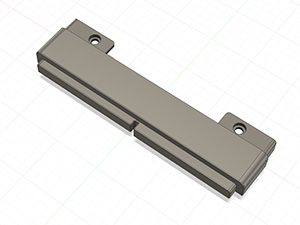
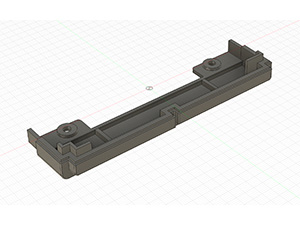
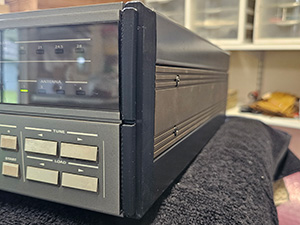
 A long-time, highly regarded ham radio service technician contacted us after seeing our 3D‑printed drop‑in replacement parts for classic electronic test equipment such as the Tektronix 465 oscilloscope. He explained that he had serviced many Yaesu FL‑7000 amplifiers over the years and that the plastic end caps were frequently cracked, faded, or otherwise damaged beyond practical reuse. With the FL‑7000 having been produced in the late 1980s and early 1990s, original replacement end caps have become increasingly scarce, and locating usable parts in good cosmetic and structural condition is now extremely difficult.
We Start The Process
After exchanging a few emails, we asked if he could provide a representative end cap in serviceable condition. Having an original sample was essential for taking accurate measurements and creating a faithful digital model. We assured him that the process would be completely non‑destructive and that his parts would be returned along with a set of prototype reproductions for test fitting and evaluation.
Modeling And Production
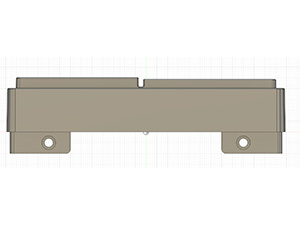
Using a ruler, calipers, and CAD software, we set out to model the Yaesu FL‑7000 end caps with as much dimensional precision and detail as possible. Although the sample parts showed normal wear—scratches, nicks, and minor blemishes—they were structurally sound and ideal for measurement. Because our production method is 3D printing rather than injection molding, we made thoughtful adjustments to internal structures and wall thicknesses to optimize printability and durability while preserving the original external appearance.
Once the initial CAD model was completed, we shared rendered screenshots with the technician and prepared a set of 3D‑printed prototypes. We asked him to evaluate the parts for fit, dimensional accuracy, alignment with the existing trim and case lines, overall aesthetics, and color suitability.
Part Evaluation
His feedback was overwhelmingly positive. He reported that the fit was correct on the very first iteration: the trim lines aligned cleanly, the outline followed the original case boundaries, and the mounting holes lined up precisely, allowing the new parts to bolt directly onto the amplifier without modification. Achieving this level of accuracy on the first pass confirmed that our measurement and modeling approach was sound and that 3D‑printed replacements could be a viable long‑term solution for these aging amplifiers.