
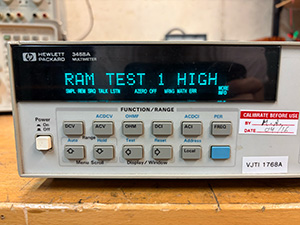
 A customer contacted NDF about an HP 3458A Digital Multimeter that displayed “Ram Test 1 High” during startup. The immediate goal was to resolve the power-on fault, but the instrument’s intended use in a certified metrology laboratory also made long-term reliability and calibration considerations important.
Our repair addressed the failed main memory, a second aging main-memory module, and the battery-backed memory used to retain calibration data. The work restored error-free self-test operation, followed by external calibration arranged by the customer before returning the instrument to service.
Investigating the Power-On Error
Research into the reported fault directed our attention to the HP 3458A’s high and low memory storage. These locations used Dallas DS1230Y-150 nonvolatile static RAM, or NVSRAM, modules. An internal battery preserves stored information when instrument power is removed.
The battery-backed construction creates an important service consideration: the memory depends on a finite-life internal power source. Our research indicated an expected battery life of approximately 10 to 15 years after activation. Both main-memory modules in this instrument carried date codes corresponding to the sixth week of 1995, making them more than 30 years old.
The startup message identified the high-memory location, but the low-memory module was the same age. Replacing only the module implicated by the error would leave another aging component in service. We therefore chose to replace both main-memory modules. Their age supported that preventive decision, although we did not independently confirm internal battery depletion as the failure mechanism.
Addressing Calibration Memory Before It Failed
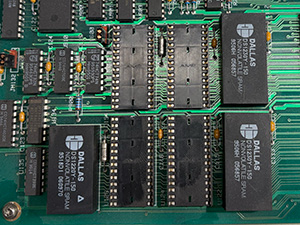 The instrument contained a third Dallas NVSRAM module: a DS1220Y-150 used for calibration storage. Although this module was not the source of the reported startup fault, its condition mattered to the instrument’s continued serviceability.
Loss of calibration data would require the instrument to undergo calibration before returning to measurement service. With the main-memory repair already requiring access to the relevant assembly, we included replacement of the calibration-memory module in the repair plan.
The service information reviewed identified HP part number 1818-4336 for the original DS1230Y main-memory modules, with 1818-4441 listed as an approved replacement. For calibration memory, the original HP part number was 1818-4335, with 1818-4333 listed as an approved replacement.
Selecting Replacement Components
We ordered two DS1230Y-150+ 256-kilobit NVSRAM modules and one DS1220AD-150+ 16-kilobit NVSRAM module from Mouser. Purchasing through a reputable supplier gave us a documented source for the replacement components rather than relying on uncertain secondary-market stock.
We also considered converting the memory locations to FRAM, which retains information without a backup battery. That approach offered an appealing long-term maintenance advantage, but the conversion options we reviewed required adapter circuit boards and introduced questions about timing compatibility, including rising-edge versus falling-edge behavior.
For an instrument destined for a certified metrology laboratory, we chose to preserve the original battery-backed memory architecture rather than introduce a DIY conversion. The priority was a controlled repair with fewer design changes, not an experimental redesign.
Replacing the High and Low Memory Modules
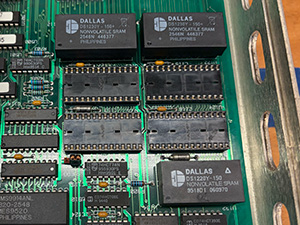 After opening the instrument, we removed the A5 assembly, identified on this unit as 03458-66505. This assembly contained the U121, U122, and U132 memory locations involved in the repair.
We began with the two main-memory modules associated with the startup fault. Using a vacuum-pump desoldering iron, we cleared the solder from each pin and removed both modules. The removal process was tedious, requiring care as each soldered connection was released.
Before installing the replacements, we fitted sockets at both locations. This made the new modules replaceable without repeating the same board-level desoldering work during a future service visit.
With the sockets installed, we inserted the two DS1230Y-150+ modules, reinstalled the A5 assembly, and reconnected the ribbon cable.
Verifying the Initial Repair
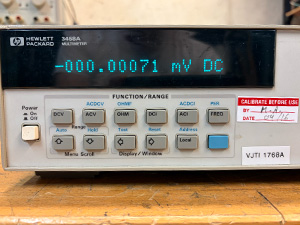 The next power-up completed without the original memory error. We then performed basic DC voltage, AC voltage, and resistance checks, comparing readings with our Fluke 8840A.
These checks supported the conclusion that replacing the main-memory modules had resolved the reported startup problem and restored basic measurement operation. They were functional comparisons, not a substitute for calibration or proof that the instrument met every published specification.
Replacing the Calibration-Memory Module
With the initial fault resolved, we returned to the remaining preventive work. We removed the A5 assembly again, desoldered the original DS1220Y calibration-memory module, and installed a socket at that location as well.
Before fitting the replacement, we used a programming tool to read the original module and save its contents as a binary file. Our intention was to transfer the existing calibration data to the new DS1220AD module.
The read operation succeeded, but attempts to write the saved data to the replacement module failed. We sought manufacturer support, but did not obtain an explanation that resolved the programming issue.
This distinction was important: we had successfully extracted a copy of the original memory contents, but we had not successfully transferred them. The saved file alone did not establish that the replacement contained usable calibration data.
Self-Testing and Calibration Handoff
We proceeded by installing the DS1220AD-150+ module, reinstalling the A5 assembly, and reconnecting the ribbon cable last. As expected with no transferred calibration data, the instrument reported a calibration-related error at startup. It did not report additional errors indicating missing or unwritable memory.
After allowing the instrument to warm up and stabilize, we completed the full ACAL routine without errors. We also ran the front-panel TEST sequence, which completed without errors and passed all self-tests.
Power cycling still produced a “Calibration required” indication. Passing ACAL and the self-tests established that those routines completed successfully; it did not replace the external calibration needed after the calibration-memory change.
The customer subsequently sent the HP 3458A out for calibration and reported that it was back in service. That final calibration outcome was customer-reported, not independently verified by NDF as part of the repair work described here.
Repair Outcome
The original power-on fault was resolved and verified through startup testing. Both main-memory modules and the calibration-memory module were replaced, with sockets added to simplify future service. Calibration-data transfer remained unsuccessful, and external calibration was required.
This repair demonstrates NDF’s approach to laboratory equipment service: investigate the immediate fault, address related aging components, preserve the instrument’s design where practical, and distinguish verified functional results from work that still requires calibration.
Contact Next Dimension Fabworks today to have your equipment repaired today.