
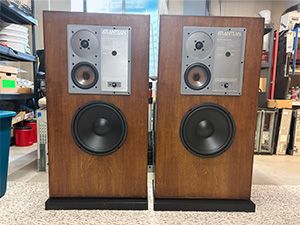
 When floodwater damaged a customer’s pair of Atlantean 110 High Performance Loudspeakers, the question was whether anything could be saved. Next Dimension Fabworks evaluated the speakers, identified the reusable components, and developed a rebuild that combined electronics testing, custom woodworking, CAD modeling, and 3D printing.
The goal was a careful restoration: preserve as much of the original design and familiar sound as practical while replacing damaged structures, addressing mismatched components, and making the finished speakers easier to service.
Assessing the Flood Damage
Both speakers arrived with visible water damage and a strong mold odor. Their bases were missing, and the lower cabinet sections were coming apart after prolonged exposure to water. The original enclosures were beyond practical salvage.
We removed the woofers, midrange drivers, tweeters, and three-way crossovers for individual evaluation. The drivers appeared visually intact but retained a strong odor after removal, so we temporarily isolated them in sealed storage tubs to be deodorized later. Fortunately, the crossovers had been mounted high inside the cabinets, away from the floodwater.
Disassembly also revealed another challenge: the plastic bezels surrounding the specification plates were extremely brittle and broke apart during removal. Replacements would need to be fabricated to preserve the speakers’ recognizable appearance.
 Documenting the Original Design
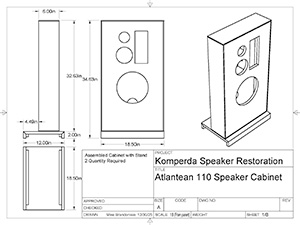
Before disposing of the damaged cabinets, we recorded their overall dimensions and driver locations, along with construction details needed for the replacements. These measurements established a reference for cabinet drawings and helped preserve the original proportions and component arrangement.
This documentation mattered because the customer already liked the speakers’ sound. Rather than treating the project as an opportunity to redesign everything, we used the existing configuration as our starting point and made deliberate changes where damage, component consistency, or serviceability justified them.
 Testing the Drivers and Resolving a Mismatch
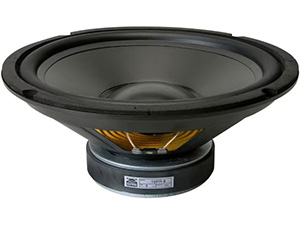
Before committing to cabinet fabrication, we tested all six drivers for operation and frequency response. Although every driver functioned, testing and visual inspection revealed that one woofer had apparently been replaced previously. The two woofers used different materials and exhibited slightly different frequency-response and impedance curves.
That mismatch was important to address before rebuilding the pair. We selected two matching modern replacement woofers based on the original woofer specifications, rather than carrying the inconsistency into the finished speakers. The original midrange drivers and tweeters remained part of the build.
 Rebuilding and Checking the Crossovers
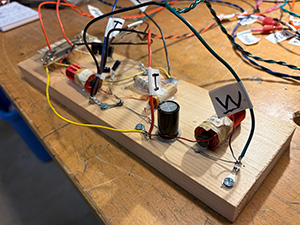
We documented each crossover component’s value and type, then created a schematic. The networks used iron-core inductors and non-polar electrolytic capacitors. We considered film capacitors and air-core inductors but chose to retain the original circuit configuration and replace only the electrolytic capacitors.
This approach kept the work focused on restoration rather than an unverified crossover redesign. Preserving the existing configuration also supported the project’s central objective: retaining the character the owner remembered.
To check operation, we swept a signal through each crossover and observed its woofer, midrange, and tweeter outputs using an HP 3577A network analyzer. The resulting traces showed the frequency-limiting behavior of each branch. This provided an electrical check before the crossovers were installed in the new cabinets.
 Building Furniture-Quality Replacement Cabinets
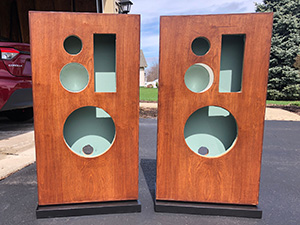
With the driver selection settled, we prepared cabinet drawings and built new enclosures from three-quarter-inch birch plywood. Construction retained the original driver placement and the isolated internal compartment for the midrange driver. We also fabricated replacement bases to complete the speakers’ original visual proportions.
For future access, we designed the cabinet backs to attach with screws. Inside, the wood received a sealer, and closed-cell rubber matting was applied to the flat interior surfaces. The exterior finish recreated the original walnut appearance with black bases, topped with a soft satin polyurethane clear coat.
The woodworking and finish were central to the transformation. The replacements needed to look like finished pieces of furniture, not simply functional boxes built around salvaged components.
 Recreating Unavailable Parts with 3D Printing
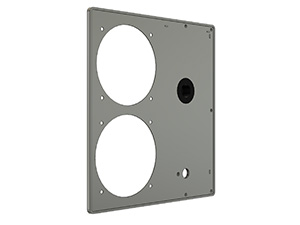
The original Atlantean 110 specification plates were salvageable, but their mounting bezels were not. Using a ruler and digital caliper, we measured the surviving features and modeled replacement bezels in CAD. We then produced them in silver-gray material on an FDM 3D printer.
The replacements had to accommodate the original high-frequency adjustment control and tweeter-protection hardware. We also designed and printed specialized alignment tooling to position the adjustment control correctly behind the specification plate opening.
A panel-mount fuse holder replaced the original mounting arrangement while retaining the tweeter-protection circuit and LED indicator. This was a targeted departure from the original construction, allowing the rebuilt assembly to retain its familiar layout without relying on the deteriorated plastic parts.
Final Assembly and Serviceability
During assembly, we tightly twisted the internal wire pairs and relocated each crossover from behind the specification plate to the cabinet bottom. Soft driver gasket tape sealed the drivers and specification-plate assemblies to their mounting surfaces. These speakers use sealed enclosures, with no ports.
Rear-mounted combination banana-plug and bare-wire terminals provided the external connections. One cabinet also received a spare-fuse holder. Together with the removable backs, these details made future inspection and maintenance more straightforward.
 Measuring and Listening to the Finished Pair
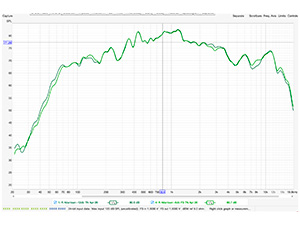
We checked the completed speakers with REW, or Room EQ Wizard, and a Sony condenser microphone. For these checks, the microphone sat approximately three feet from each speaker, vertically centered on the cabinet. Sweeps covered 20 Hz to 20 kHz at approximately -12 dBFS.
The two speakers produced similar measured responses. The curves showed rising bass output into the lower midrange, a broad midrange emphasis peaking around 1.2 kHz, and declining upper-frequency output with a smaller rise near 10 kHz. These were measurements in the listening/test setup, not a claim of anechoic response or laboratory-certified performance.
Music listening complemented the measurements. The pair sounded very good, although the midrange was more prominent than the low and high frequencies. The final system paired the rebuilt speakers with a Fisher ten-band stereo equalizer and a Ming Da tube amplifier. The ten-band stereo equalizer will allow adjustments for listening in the final destination.
A Restoration That Brought Multiple Skills Together
The customer was astonished by both the finished appearance and the performance of the speaker-and-amplifier combination. What began as an assessment of flood-damaged equipment became a complete rebuild around selected original components.
For Next Dimension Fabworks, the project demonstrates how measurement, electronics repair, custom cabinetmaking, and digital fabrication can work together. Each discipline addressed a different problem, producing a cohesive result that respected the original speakers while giving them new cabinets, matching woofers, recreated trim, and improved service access.
Contact Next Dimension Fabworks today to start your loudspeaker build or restoration today.